Sunday, October 26, 2014

The Last Shah's Penultimate Birthday: October 26, 1978

I am in the process of revising my memoir, Phantom Iran, which is about life in Iran during the political turmoil of 1978-79, when the Islamic Revolution was brewing.  Today I am posting part of a chapter from the memoir which describes an event that occurred exactly 36 years ago:

Thirty-six years ago, in the fall of 1978, I was an American graduate student doing research in Iran during a time of frequent anti-Shah protests.  One of these protests, on October 26, 1978, was the day of Mohammad Reza Shah’s sixty-ninth birthday.

I remember seeing photos of the Shah and his third wife, Farah Diba, perhaps when Life magazine covered his 1967 coronation.  To me, the two Persian royals appeared dignified and glorified, he in gilded military regalia, she swathed in jewels, both draped with gold-embroidered cloaks.  Farah Diba’s green velvet cape, with its extended train, was embellished with diamonds, rubies, and emeralds.  On their heads rested crowns heavy with gemstones.  Between them stood the seven-year-old Crown Prince Reza. 

Coronation of Mohammad Reza Shah, October 25, 1967


This official coronation occurred twenty-six years after Mohammad Reza Shah had taken over the throne from his father, Reza Shah, during World War II.  The Allied forces, afraid that Reza Shah’s policy of neutrality during the war made Iran too close to the Nazis, forced him to abdicate in 1941.  Mohammad Reza, then just 22, became the monarch of Iran.

During his opulent 1967 coronation, Mohammad Reza Shah took the title “Shahanshah” (King of Kings) for himself.  He rendered its translation in English as “emperor.”  The Shah designated Farah Diba—his other two marriages had ended in divorce because the wives did not produce a male heir—the “Shanbanou,” or Empress.  He also had himself referred to as “Aryamehr”—“Light of the Aryans.”

The Shah enjoyed being the center of opulent pageantry, the most pompous of which took place in 1971 to celebrate 2500 years of Iranian monarchy, from the rule of Cyrus the Great of the 6th century BCE to his own sovereignty in the 20th century.  The Shah invited world leaders to a hundred million dollar lavish festival held from October 12 -16 at a 160-acre tent city created at Persepolis, the ancient capital of Iran’s Achaemenid dynasty (550-330 BCE).   French chefs prepared exotic dishes for the guests, who ate off Limoges china and drank from Baccarat crystal.  The villagers in the vicinity lived in mud-brick huts without electricity or running water.

Tent at Persepolis tent city


Parade in front of Persepolis 1971

By October 1978 anti-Shah political turmoil was spreading, and the Shah realized that public ceremony celebrating his birthday that year was imprudent.  Gatherings to glorify him had been revoked.  Instead, the Shah said he would contribute money meant for his birthday festivities to the 2,000 survivors of a 7.8 earthquake that had occurred six weeks earlier in the town of Tabas.  That earthquake had devastated the town and killed 15,000 people.


Tehranis I spoke to that week in 1978 had anticipated trouble on the Shah’s birthday.  Demonstrations, many said.  Overthrow of the Shah, some professed.   Formation of a constitutional monarchy, others hoped.  I didn’t know what to expect.


I was staying in central Tehran at the hostel of the American Institute of Iranian Studies, whose function was to help American academics with some of the bureaucratic entanglements they inevitably encountered. The hostel compound, which was an old house and yard surrounded by a high wall, was located across the street from the Institute’s main building where the Institute’s director lived.

By 9 AM the morning of the Shah’s birthday young men were marching near the American Institute’s hostel, bellowing "marg bar shah" (death to the Shah) and denouncing the kharaji and farangi, two terms meaning "foreigner."  Sometimes the demonstrators ran down the alley in front of the Institute.  Even boys ten or eleven years old joined in.  The four of us staying in the hostel took turns watching through a large keyhole in the door of the compound’s wall.  Helicopters flew low, as if spying or poised to shoot.
            
The young men we watched from the peephole were protesting against the Shah.  They were not rallying for an Islamic state.  They wanted the Shah out of power, and some wanted him dead.  The Shah had been a dictator for decades, loved by some, hated by many.  His autocracy emerged in 1953, twelve years after he had taken over the title from his father.  At that time his popular prime minister, Mohammad Mossadegh, had nationalized the Anglo-Iranian Oil Company.  This action pleased the Iranian public.  The British and Americans, though, were furious at having lost their control over Iranian oil.  They ousted Mossadegh in a coup d’état in August 1953.  After the coup, the Shah’s rule became more imperious.  His CIA-trained secret police, Savak, imprisoned and tortured thousands of political dissidents. 

By ten thirty that morning the director of the Institute entered the hostel compound.

“Don’t go outside,” he warned as he walked in.  “Soldiers are everywhere.”  He sat down with the four of us in the courtyard.  He folded his hands, rested them on the metal table, and continued.  “Apparently, the demonstrators knew the soldiers were coming.  They moved cars into the street to block them.  But the army materialized some vehicle that could lift the cars and put them down by the side of the road.”  He looked at us as if he were waiting for a response, but none of us said anything.  “Okay, just stay inside the compound,” he cautioned.  Then he left.
            
We heard gunshots.  Demonstrators and soldiers raced through our neighborhood.  My heart was pounding so loudly that I feared the demonstrators could hear it and would demand to be let into the courtyard.
            
By two in the afternoon everything was quiet.  I wanted to use the Institute’s phone in the main building to call friends of mine who lived in a northern Tehran neighborhood to find out what happened there.  Bob, an archeologist staying at the hostel, decided to join me.
            
I wrapped myself in the black chador that I had bought on my first trip to Iran in 1975.  My right hand held the chador clinched around my chin.  With my hair covered, my body concealed, and my face exposed, I opened the hostel’s metal door two inches, then pushed it wide enough to stick my head out.  I saw no protesters on the street.  Three young men were talking to each other several houses away.  Garbage bags were piled outside the door of the American Institute waiting to be picked up. 

Bob and I crossed the street.  In less than no time, the three young men were standing next to us.  They lit matches and set the garbage on fire.  I rang the Institute’s doorbell, once, twice, three times.  No one answered.  My knees were shaking.  I felt weak.  I was perspiring.
            
I was wearing a chador, but my American sandals were showing and they were flat with thick straps—a good-for-walking style, the type that no Iranian woman would wear in 1978. 
            
One of the men lit a paper bag.  He thrust it so close to my face that its heat tingled my skin.
            
"Come, lady...come, lady...come, lady..." he taunted in Farsi.
            
My feet were barely holding my body upright.  Sweat soaked me.  My hand trembled as I pressed the doorbell again.
            
At last the Institute's director peeked out the door.  We rushed in, pushed him out of our way, and slammed the gate behind us, leaning on it to make sure it was shut.  The director stared at us.
            
“Sorry about that,” he said.  “ We didn’t see you, and we didn’t hear the doorbell.”  He led us into the dining room.  “We were on the third floor watching what was going on in the streets.”    
            
He made me a lime vodka drink with the refreshing tart lime juice particular to Iran.  I sipped it, relished it, needed it to calm my pounding heart and the intense disquietude I felt.  In spite of Islam's taboo on alcohol, pre-revolutionary Iran had decent vodka.
            
By four in the afternoon, tranquility permeated central Tehran.  In the early evening Bob and I walked to Govinda's, the local Hare Krishna joint, for dinner.  How strange—on that birthday, that day of riots—to smell the incense and the mélange of Indian spices, and to talk to English-speaking Hindu-practicing Western waiters dressed in saffron robes.  After dinner we strolled back to the Institute.  Stores were open.  Men, women, and children were walking on the streets, talking, smiling, and laughing.  It was as if nothing at all had happened that day.

©Karen Lee Pliskin, Ph.D.


Thursday, October 16, 2014

Amtrak and Railing about Railroads


On a recent Sunday, after a short visit to Canada, Spouse drove me to the Amtrak station at 75 Exchange Street in Buffalo, NY.  I was headed to Albany to see my dear childhood friend, and Spouse was going to the airport to return to California.  We planned to get to the station somewhat early so that we could have coffee before I boarded the train for the six-hour trip. 

Amtrak Station, 75 Exchange St., Buffalo, NY

The small brick train station, in the middle of nowhere under a maze of high-rise highways, was closed. A sign posted on the door informed passengers that the depot was open Monday to Friday from 6:30 AM until 4:00 PM.  There was no place nearby to get coffee.  Spouse dropped me off and headed to the airport.  I walked to the other side of the train station to find a few passengers, no toilet facilities, and no benches.  

Sign telling that the station is closed weekends and nights


Closed Amtrak station with no benches for passengers

At least the day was warm and sunny.  But Buffalo is infamous for inclement weather.  What do passengers do if they’re sick, need a toilet, need to sit down, or get refuge from cold rain or the biting snow of blizzards?  Is this the best we can do for our national passenger train service?

Standing or sitting on suitcases while waiting


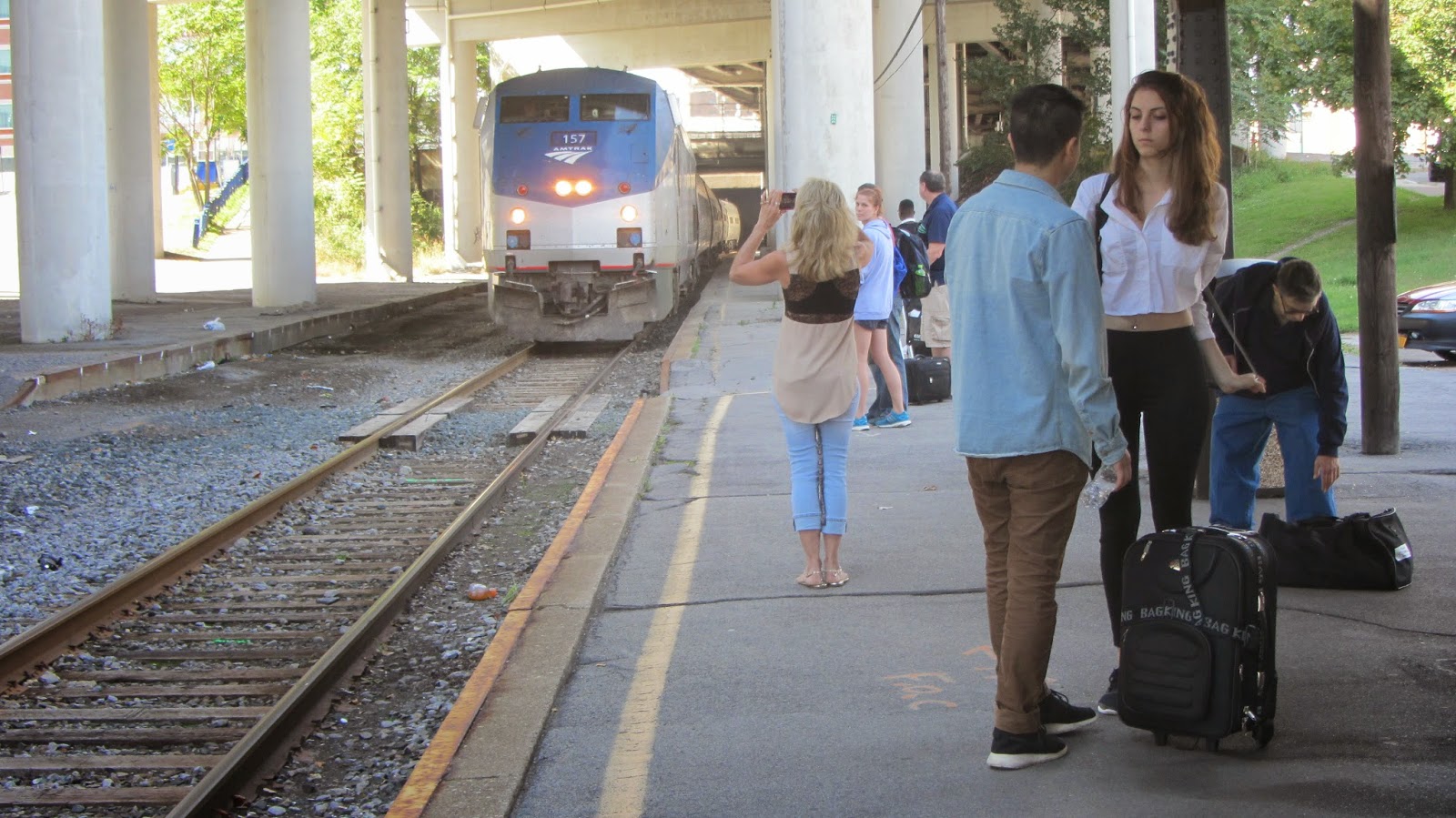
Amtrak's Maple Leaf train approaching

At least 25 people boarded the train that came fifteen minutes late from Toronto.  I sat in a comfortable window seat.  We passed Buffalo’s bygone spacious train station, now dilapidated, stranded, and overgrown with weeds like a ghost town, and then we entered a landscape of trees whose leaves were morphing into the reds of fall. Soon the train stopped. In the middle of the trees.  Just stopped.  For twenty minutes. 

View of fall trees from stopped train

The train plodded along the tracks and every once in a while it stopped between cities for ten, fifteen, or twenty minutes. I asked the conductor why all the standstills, and his answer surprised me.  Amtrak has to cede usage of the tracks to freight trains run by CSX Corporation, the company that owns the tracks.  

Amtrak, our publicly-funded passenger rail system run as a for-profit corporation, is like a share-cropper who has to pay the landlord to use the land.  CSX owns 2800 miles of track in New York State.  Amtrak owns 150 miles.  As a result, the Maple Leaf train, the one I took that goes from Toronto to Manhattan, was on-time less than 37% of the time for September 2014 because of train interference, 84.4% of which were from CSX freight trains.  We were more than two hours late getting into Albany.

CSX moves consumer goods – not consumers.  They transport cars, food, coal, chemicals, petroleum products, and industrial waste.  Their CEO, Michael Jon Ward, made $12,444,632 in 2013.  The CEO of Amtrak, Joseph H. Boardman, made $350,000 in 2013.

The United States has one of the worst passenger train systems in the industrial world. If China, which has a land mass that’s 1,933,018 square kilometers more than that of the continental U.S., can have the world’s longest high speed rail system, why can’t we have high-speed passenger trains?  Japan has had the bullet train since 1964.  France has had the TGV (Train à Grande Vitesse) since 1981.  Spain has high-speed rail.  So do Italy and Germany and other European countries.  By contrast, we have high-speed railroad derailment by politicians and corporations whose only thought is their bottom line.  Shame on them, and shame on us for just standing by as freight trains that move commodities monopolize the tracks and we American citizens are left stranded with a regressive passenger railroad system that does not meet our needs.  This is a national disgrace.


Sunday, September 14, 2014

The Resurrection of CERN Wife

Stone of Unction, Church of the Holy Sepulchre, Jerusalem


CERN Wife has been resurrected.  Its demise in cyberspace occurred more than two years ago when we returned to Oakland from Ferney-Voltaire, France.  I had plans to continue the blog with essays about life in Oakland and still write about France.  But I couldn’t figure out how to change the subtitle from “Spending a Year in Ferney-Voltaire” – which I wanted to leave on the blog for the time we were in Europe – to “Oakland Life”.  When I changed it, everything changed to “Oakland Life” – including all the posts I had written in France.  I also didn’t want to put the Ferney postings on a separate page in a navigation bar.


I googled Google, the parents of Blogspot, to find out who worked on its software.  I wanted to get help from the source.  No luck.  You can google Google but you can’t get any of Google’s information about its staff.  Although Google can get all sorts of facts (true or not) about all sorts of things and people, it’s impossible to penetrate Google - especially on Google.  So CERN Wife was buried in cyberspace because of my inability to modify the subtitle in mid-blog.

Every once in a while, I’d think about reviving cernwife.blogspot.com, but the subtitle dilemma and the boredom of my Oakland life blocked me.  I resumed my work as an artist. Spouse has continued his work in the U.S. and at CERN, and he travels to international physics meetings every few months.  In the past two years, CERN Wife has accompanied Spouse to three of these international meetings.

Voila!  

An idea for the resurrection of CERN Wife occurred to me a month ago when we were at a physics meeting in Crete: just change the subtitle to include the beginning of the blog up to the present - “Adventures in Ferney-Voltaire and Exploits of a Nom de Guerre.”  Why did it take me two years to think of that? 

Now I’ll go back to October, 2012, three months after we left France.  That’s when I experienced my first exploit as CERN Wife after spending a year in Ferney-Voltaire.  I went with Spouse to Israel.

Street of Weizmann Institute, Rehovot, Israel


Rehovot, Israel
I accompanied Spouse to an international symposium in honor of his dissertation advisor, Itzhak Tserruya, at the Weizmann Institute in Rehovot, Israel.  The title of the symposium was “Hot Topics in Hot Matter”.  Although the presentations were incomprehensible to me, I couldn’t help but think about physicists’ choices of terms and metaphors to convey their concepts.

Subject of Symposium

International physicists listening to lecture

CERN Wife, Yitzhak Maron, and Itzhak Tserruya

Aside from attending the talks and the evening celebrations in Rehovot, we toured several spots in Israel. 

Jerusalem

Jerusalem, one of the most beautiful and fought-over cities in the world, was my home for two and a half years while I was doing my dissertation research.  If only Jerusalem lived up to the meaning of its name: city of peace.  One blog post can’t begin to describe the physical and social changes that have occurred in the city in the past few decades, or the ethnic and religious diversity of its citizens, or its beauty and charm.  I won’t even try.  A few photos will suffice.


The Edicule, Church of the Holy Sepulchre


Ultra-Orthodox couple

Israelis and Palestinians wait for the light rail train

Mahane Yehuda Market

Retirees play backgammon, Mahane Yehuda tea house 

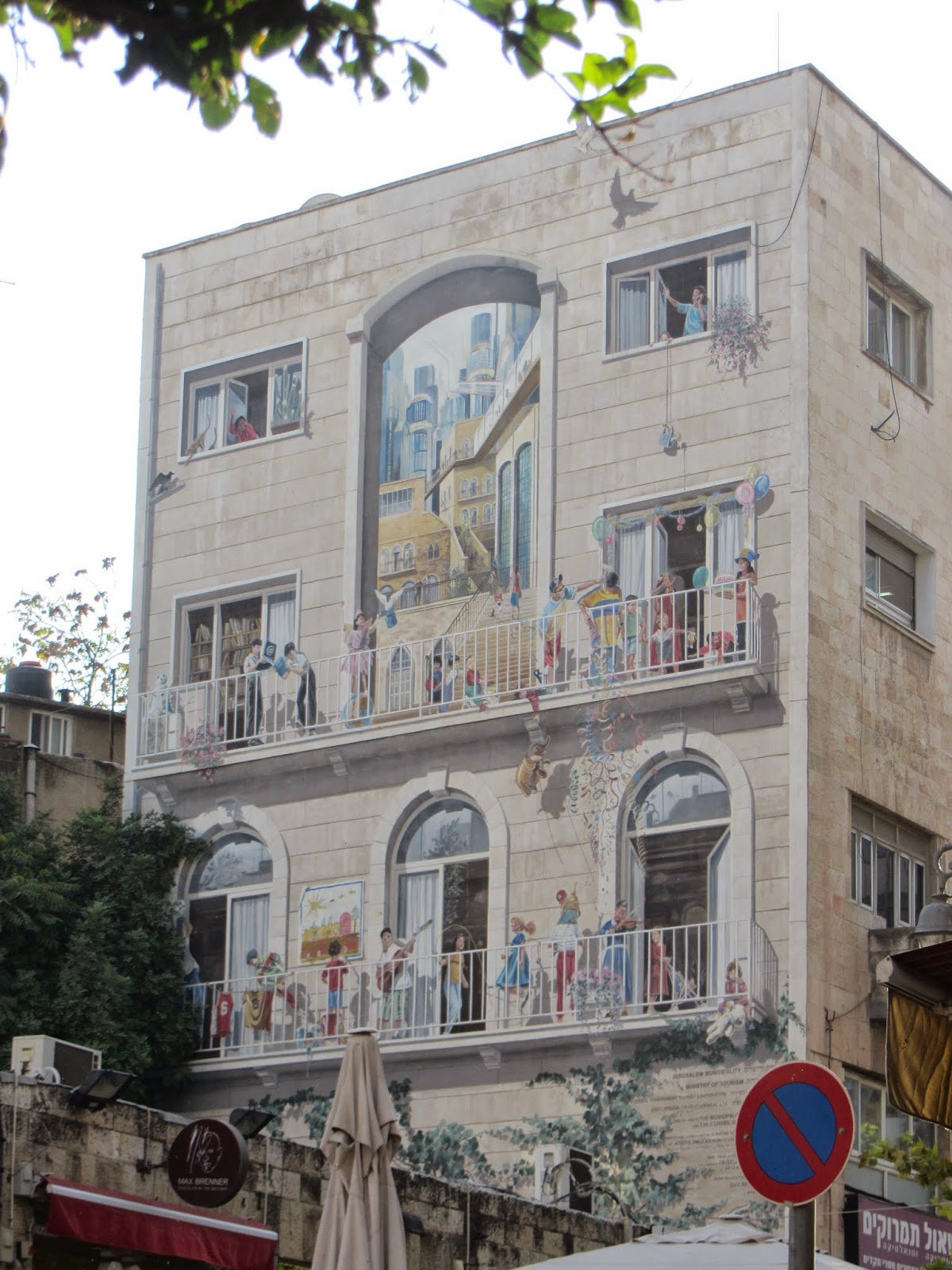
Trompe l'oeil, downtown Jerusalem

Trompe l'oeil detail

Preety Woman - Boutique with an accent

Neve Shalom
We spent an afternoon at Neve Shalom/Wahat al-Salam, the only planned Christian-Jewish-Muslim village in Israel. One of the founders of Neve Shalom was a doctoral student with Spouse.  The village of over 50 families hosts educational workshops for Israeli and Palestinian adults, teenagers, and children in their School for Peace.  The village’s Fred Segal Library has books on peace and conflict studies, health and nutrition, and Hebrew and Arabic literature, as well as rooms for meetings about peace and human rights issues.

Playground

Sign for Library

Haifa
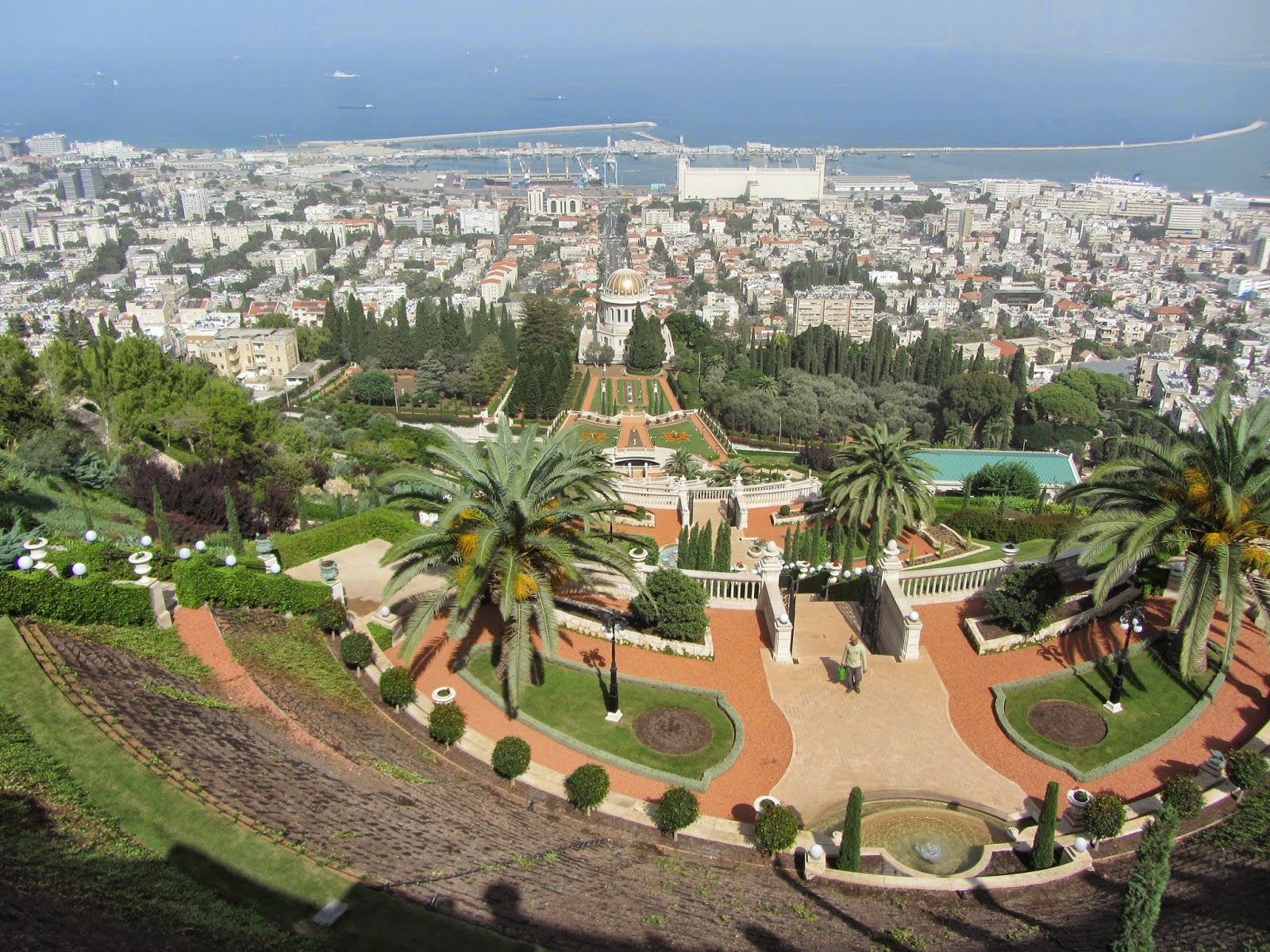
Haifa is an Arab-Jewish city built on hills overlooking the Mediterranean port. Perhaps its most famous landmark is the golden dome of the Shrine of the Bab and the terraced manicured gardens of the Baha'i World Center on the northern slope of Mount Carmel.  The 
Bab, born in Shiraz, Persia, in 1820, was the founder of Babism and a forerunner of the Baha’i faith. He was shot at the age of 30 in Tabriz, Persia.  His remains were transported over the years from Persia to Damascus to Beirut to its final resting place on Mt. Carmel, where the Bab was interred in a tomb in 1909.  The striking Shrine that we see now was completed in 1953.

The Baha'i Gardens overlooking the Mediterranean

The Shrine of the Bab

Wadi Nisnas, Haifa's Arab quarter, hosts "art of co-existence" on walls of buildings.  One noticeable example is a ceramic piece by Israeli artist, Chaya Toma.  A Jewish widow with a young son, she married a Palestinian-Israeli and had another son.  Her two boys are represented in the artwork, which has inscriptions on top in both Hebrew and Arabic.

Ceramic wall art by Chaya Toma

 
Israel is a hot topic with many hot matters.  I will discuss none of them at present.  But now with the resurrection of CERN Wife, perhaps posts on hot topics and hot matters will appear in the future.  After all, if physicists can discuss such subjects, why can’t anthropologists?  


Thursday, July 26, 2012

Farewell, Ferney

Packing

When we returned from our Bulgaria trip, we spent 10 days sorting, discarding, and packing our belongings. How did we accumulate so much in 10 months?  Assorted books bought, some clothes purchased, several household items acquired at Ferney’s community-wide garage sale in September, a half dozen black stones laden with fossils picked up from flat dry land (remnants of a prehistoric sea) in Morocco during our Christmas vacation, two diminutive art pieces obtained at Lyon’s Sunday artisan market, miscellaneous French food items that are pricey in California… These acquisitions and others added to the mass of items we had brought to France: suitcases of clothes for 4 seasons for 3 people; books to read and tour guides to use on trips; our computers and cameras; art supplies; Spouse’s bike disassembled and packed in a secure, stout, durable black plastic bike box.  We ended up with 9 suitcases to take with us on the plane, 8 boxes and the bike crate to ship air freight, and 4 boxes of books to be sent through the post.

We made trip after trip to Spouse’s CERN office to store the suitcases and boxes because our apartment lease ended on June 30, and our tickets back were for July 6.  We stayed 5 nights in a hotel.

Storage at Spouse's CERN Office

Our final day in the apartment was sunny, humid, and the hottest of the summer: 35 degrees Celsius, or 95 Fahrenheit.  With no air conditioning, working nonstop to finish packing by 6 PM, then cleaning the apartment, we were exhausted, sweaty, and tired.  But that evening we attended a community-wide festival, La Fête à Voltaire, held on the grounds of Voltaire’s chateau.  Blue, violet, and pink lights shined at different times on the chateau and church (which Voltaire had built).  Different civic organizations from the area sold food and drinks.  Not only could we buy traditional French fare, like crepes or champagne, but we also could purchase food from clubs of immigrants: Ethiopian, Moroccan, Haitian, Spanish, Russian, Tongan, West African and others.  On one stage a group of costumed folk dancers and musicians from Bourg-en-Bresse, the largest city in the département (province), performed and then taught dances to attendees of the festival.  And a community chorus of adults sang a cantata by Jean-Philippe Rameau (1683-1764), a contemporary of Voltaire.  In fact, Voltaire had written a libretto for one of Rameau’s operas, Samson, but it was never performed because Rameau feared that Voltaire’s criticism of the Church would create public discord. 

Voltaire's chateau in violet light

Between “La Fête à Voltaire” on Saturday night – which seemed to be a suitable and sad adieu to Ferney - and our departure the following Friday, we dined with friends we had seen throughout the year and we toured places we hadn’t seen – a cheese factory in the Jura Mountains and a medieval town with an interesting religious history, both of which I’ll write about in the next few months.  

Cheese factory in the Jura Mountains

I drove around Ferney taking last-minute photos of scenes I wanted to remember, such as the statue of nude lovers which is located near the apartment where we lived, on a corner by the main road that connects Ferney-Voltaire to Meyrin, Switzerland.  We passed that statue at least twice a day when I drove Spouse to and from CERN.   Whenever I saw the sculpture, I assumed that Americans would ban from public display such a carving of a couple embracing in the buff, and I thought, “Vive la France!”

Embracing Nudes in Ferney-Voltaire

The day before we left France we took the boxes and bike crate to an air freight company at the Geneva Airport.

Our air freight load

And then on July 6, the three of us, with our 9 suitcases and carry-on pieces, bid farewell to Ferney. 

CERN Wife and luggage at Geneva Airport

Although we didn’t spend an entire year in Ferney-Voltaire, we are fortunate for having had 10 months to live in France.  CERN Wife, however, will continue to write about French culture, which has been the subject of this blog.  But from now on, the blog posts will be written in Oakland, California.  France from not France.  Now that’s interesting.