Monday, June 11, 2012

Hard Probes

The beach at Cagliari, Sardinia


The language of high energy physics is something that social linguists, like George Lakoff, would enjoy, because these physicists explore a world they can’t see without the help of technology, and they create names - like quarks and gluons - for the concepts of their theories and experiments.  These names interest me, as an anthropologist.  But I don’t have the time or understanding to delve into the anthropology of high energy physics in order to analyze the words that are used to explain the physics knowledge that people talk about at CERN and elsewhere.  I just wish that I could ask George Lakoff and Mark Johnson, who wrote Metaphors We Live By (1980) to do such a study.  Or maybe a linguistics or anthropology PhD student.  The question is how high energy physicists use metaphor to explain what they are doing and thinking.  According to Lakoff and Johnson, metaphor refers to “experiencing one kind of thing in terms of another.”   To use a metaphor, I’m in deep water just trying to write this, because I’m sure the physicists who read what I’m writing will say I’m wrong.  

Why the term “quarks”?  It was coined by the physicist Murray Gell-Mann, who received the 1969 Nobel Prize in physics for his work on the theory of elementary particles and the discovery of the “quark.”  In fact, Gell-Mann took a nonsense word from James Joyce’s poem in Finnegan’s Wake: “Three quarks for Muster Mark!/Sure he hasn't got much of a bark/And sure any he has it's all beside the mark."  Quark – unbeknownst to Joyce – became a building block of matter.  But now with more theory and more discovery in high energy physics, there are differentiated quarks: up, down, charm, strange, top, and bottom.  Some of these terms, in Europe, had been called something else: open charm and beauty.  Talking about metaphor…

Lakoff and Johnson write that “many aspects of our experience cannot be clearly delineated in terms of the naturally emergent dimensions of our experience.  This is typically the case for human emotions, abstract concepts [my emphasis], mental activity, time, work, human institutions, and social practices, etc., and even for physical objects that have no inherent boundaries or orientations.  Though most of these can be experienced directly, none of them can be fully comprehended on their own terms.  Instead, we must understand them in terms of other entities and experiences, typically other kinds of entities and experiences” (Metaphors We Live By, 1980:177).

So, CERN physicists have quarks, gluons, leptons, and other things I’ve heard about but barely comprehend, but I do know that the names are sometimes arbitrary – as in quarks – or descriptive – as in “top quark” and “bottom quark” (which Lakoff and Johnson would say are metaphoric descriptions).  At times, though, I think that this physics community should hire a branding consultant to help them figure out that some names are not just descriptive of their own work, but connote distinct metaphors for non-physicists.  Take the name of a physics conference that has been occurring every 2 years since 2004.  The first one was at the coastal town of Ericeira, Portugal in 2004, and ever since, the conference has been somewhere near the sea: 2006 at Asilomar in California; 2008 at Illa da Toxa in Galicia, Spain; 2010 at Eilat in Israel; and this year at Cagliari, Sardinia (Italy).

Balcony of house, Via Giovanni, Cagliari


On Via Giovanni, Cagliari


Back in 2004 when I’d first heard of this conference, I burst out laughing. “You’ve GOT to be kidding!” I said.  “What’s so funny about the name?” asked the physicist who told me he was going to be presenting a paper at the conference.


“Hard Probes?  A conference called ‘Hard Probes’?  What were you guys thinking?  Doesn’t anyone speak English?  There’s only one thing I can think of when I hear that term, and it has nothing to do with physics.” 

The physicists didn’t think my comment funny. 

Top part of the conference poster

Bottom part of the conference poster
(notice the beach scenes)

I was an accompanying CERN wife at two Hard Probes conferences, the one in Spain in 2008 and the one that just finished in Sardinia.  I enjoyed exploring Cagliari, savoring gelati, walking on the beach collecting tiny pink seashells as the water lapped my ankles, learning about a prehistoric people called the Nuraghi who settled Sardinia in the 18th century BCE, and feasting at dinners with the physicists and some of their spouses. 

A Nuraghi fortress at Barumini, Sardinia


Physicists at Cagliari's beach before the banquet


At the Hard Probes banquet

But I don’t think that these serious scientists realize that the titles of their conferences could be metaphors with other meanings to other people, like the newest conference that’s going to be happening this October: Hot Quarks.

As I write in my blog bio, “Physicists could be considered bigamists because they seem married to their work.”  No wonder they have conferences called “Hard Probes” and “Hot Quarks.”

Metaphorical flower
on tables in the lobby and bistro at Cagliari's THotel,
where the Hard Probes 2012 conference took place


Wednesday, May 30, 2012

La Frère Fête Française à Ferney


Before moving to Ferney-Voltaire, I fantasized having a reunion in France of my coterie of high school girlfriends (and their spouses).  Decades ago our circle of seven young women of different religious and racial backgrounds hung out together before classes started, ate lunch together in our rural school’s cafeteria, and in spite of living miles away from each other, got together once in a while on weekends.  By our senior year we had become a congenial clique, although we didn’t allude to ourselves that way.  Our self-reference signified our social ideals: after an assembly during National Brotherhood Week in February of our senior year, we decided that the 7 of us were a Brotherhood.  From then on we called ourselves “Brothers.”

For over twenty years we’ve had Brotherhood reunions, most of which have taken place in the East Coast.  But as the Brother who lived so far away from all the others (California), and who was the oldest mom with the youngest child, I missed out on most Brofests, as we call our gatherings.  So I decided to host a Brofest in France, la Frère Fête Française.  

Although only two of the Brothers, Donna (whom I’ve known since kindergarten) and Jan (whom I met in high school), were able to make it to Ferney, our six-day Frère Fête introduced them to “my” part of France and neighboring Switzerland.  I prepared food for them from Picard, cooked meals from scratch, took them on trips to other towns and to stores I like (food stores, of course), and drove them through the undulating landscape of fields and farms, grazing cows and nibbling sheep, espaliered fruit trees and budding vineyards.  Sharing this part of the world with some of my oldest and dearest friends, and listening to their expressions of joy and wonder (not a Christmas cliché here) delighted me and vindicated me: yes, there are valid reasons why I enjoy living here.

CERNwife, Donna, and Jan


The Six-Day Frère Fête Française Whirlwind Tour

Day One:  Donna and Jan took the high speed TGV train (why don’t we have such trains in the US?) from Paris to Geneva.  After I picked them up and took them to the motel in Ferney-Voltaire to register and drop off their luggage, we headed up the Jura to a lookout point so that they could see the valley surrounding Lac Léman, Geneva, the Alps, and the part of France that has been my home since September.  Then we went to CERN to pick up my physicist Spouse (spouses, in the language of the Brothers, are referred to as “spice” – rhymes with mouses and mice).  And we did what many CERN scientists do in the late afternoon: sat around a patio table and sipped beer (Coke for Jan).

Having a drink at CERN


Day Two:  During the relaxing 45-minute drive to Annecy on a 2-lane country road, we passed through picture-postcard vistas of villages, rolling hills, farmland.  Annecy is an alluring city with canals, flowers, Renaissance buildings, boutiques and gelato stores, a chateau overlooking the town, a romantic botanical park that borders the clean and serene Lac d’Annecy (France’s second largest lake), and mountains that jut out from across the lake, where hand-gliders jump off cliffs and risk their lives for the views. The old town’s buildings and boutiques amazed Jan and Donna, who would have spent more time shopping if I didn’t complain about being hungry.  We bought lunch at a boulangerie/patisserie (a “formule” it’s called: one sandwich or pizza slice or quiche, a drink, and a dessert of choice for around 6 euros), and sat in the park near the lake to eat our picnic.  By late afternoon we returned to the Ferney area via the 20-minute autoroute drive because, as the spouse-chauffeur, I had to rush to CERN.  


Jan, CERNwife, and Donna at Annecy
(Jan's photo)
 
Crooked door of an old Annecy store

Lily of the Valley decorated chocolates (from May 1)
at one of Annecy's gourmet chocolateries

Day Three:  This day we relaxed in Ferney-Voltaire.  In the morning we walked to Ferney’s marché (yes, Jan and Donna were sufficiently awed), did a tour of Voltaire’s chateau in the afternoon, and ate dinner at a captivating country inn located in Echenevex, a village nestled in the Jura foothills. 

The three Brothers at the Ferney market

Jan and CERNwife in front of Voltaire's chateau

Dinner at Auberge des Chasseurs, Echenevex

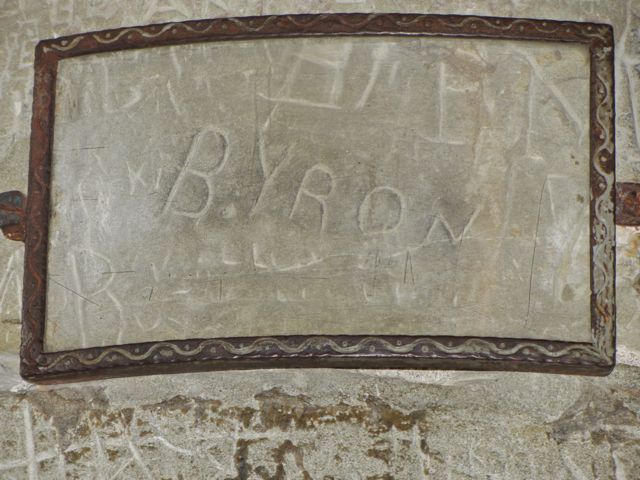
Day Four:  Lac Léman, the largest lake in Switzerland (known as “Lake Geneva” to many Americans), is so picturesque that describing the lake and the towns, mountains, terraced vineyards and villages that surround it is impossible without seeming platitudinous and vapid. Some scenery is better just to experience. That’s what we did on Day Four by taking the 2-lane lake route (rather than the 4-lane autoroute) to the captivating Swiss town of Morges, where we strolled through a somewhat boring crafts fair that was held in Morges’ 13th-century chateau.  Then we drove to one of Switzerland’s spectacular tourist venues, the medieval Chateau de Chillon, built on a rocky promontory that juts into Lac Léman within site of snow-covered Alps.  Walking through the cobblestone courtyards, climbing up and down stairs, examining various rooms of the chateau, and exploring the dungeon, where Lord Byron’s graffiti signature on one of the columns is marked by a frame (remember, he wrote “The Prisoner of Chillon”), we were like children playing make-believe.  Chateau de Chillon casts that spell.

The moat at Chateau de Chillon

Lord Byron's carved graffiti (framed)

In the world of make-believe

Day Five:  The salad bar at CERN’s cafeteria awed Jan and Donna as it had me.  My CERN Spouse just doesn’t understand how the three of us could get so excited by a salad bar, but we can.  After lunch he put on his tour guide cap and took them to the Microcosm, the museum that explains the kind of physics experiments that occur at CERN.  We headed to a model of the detector used in the ALICE experiment, which, considering Spouse works on ALICE, formed the framework for his explanation of CERN physics.  From the Microcosm we drove to the ALICE experimental site, but we couldn’t go down 100 meters into the tunnel to see the real detector because the site has been closed to visitors and employees since March: the experiment’s collisions of particles are occurring down there.  I think that by the end of the day, Donna and Jan were more impressed with CERN physics – whether or not they understood it is another story – than they had been with the CERN cafeteria.

Model of the ALICE detector at the Microcosm

Spouse, Donna and Jan at ALICE display

Day Six: Yvoire, regarded as one of the most beautiful villages in France, fills with tourists during vacations and holidays.  Although Yvoire is said to be a medieval village, in fact, most of its gray stone buildings hail from the early Renaissance, although its chateau (it seems as if every village I’ve written about here is dominated by a chateau) began its life during the 14th century.  From Ferney-Voltaire, one can get to Yvoire by taking a boat across Lac Léman from Nyon, Switzerland, or one can partially circumnavigate the lake by skirting Geneva (our way of getting there).  We walked around its cobblestoned streets, admired the colorful potted flowering plants that decorate the gray buildings, peeked into Yvoire’s shops, and ate a leisurely lunch of “filets de perche” – tiny perch filets fried in butter and served with pommes frites – the specialty of French and Swiss restaurants bordering Lac Léman.  Walking fast and not going into stores, tourists could see Yvoire in 20 minutes or less.  It’s a small treasure.  But we went in and out of boutiques and tried on clothes, walked into galleries and tourist shops, and relaxed at a restaurant by the harbor – with a view of Switzerland across the lake - for our midday meal of perch filets.  We stayed in Yvoire at least 3 hours.  Maybe more.

A street in Yvoire

CERNwife and Donna eating dessert, Jan with spoon

Day Seven:  I picked up Jan and Donna from their hotel at 7 AM and drove them to the Geneva Airport for their flight back to Washington, DC.   After our usual emotional Brotherhood good-byes, I left them in the departure section of the airport and walked downstairs to the arrivals.  My 89-year-old mother was coming for a two-week visit.


Sunday, May 6, 2012

Picard's Foods

The Picard store in Ferney-Voltaire


Picard is my favorite French grocery store.  Although they don’t carry milk, cheese (a necessity in France), seltzers (or wine and beer – additional necessities), salad greens, and some other staples, which means I make the rounds of different food markets, Picard is a specialty-item enterprise: they sell frozen foods. 

Picard's rows of deep-chest freezers

Picard’s stores look somewhat sterile, with rows of deep-chest freezers packed with tempting packages whose alluring graphics of the foods within entice buyers like me to pick up more foods than the tiny French freezers could hold.

Flash-frozen fruit

The company flash-freezes fresh produce or prepared products, which preserves their texture and taste.  Picard’s non-GMO foods are gourmet, flavorful, well-made, easy to use, and do not have artificial preservatives or flavorings.  But what makes Picard my favorite French grocery store is the choice and the fact that whatever I buy doesn’t taste like frozen food.  Take, for example, frozen spinach.  In the US, I could buy a 10 oz block of frozen spinach, but what if I want to use just a quarter cup?  I’d have to take a hammer or saw to cut it up, or thaw out the entire thing and toss most of it out.  Picard’s frozen chopped spinach, on the other hand, like all their pureed vegetables in bags, are molded into individual little rectangles, around an inch by an inch and a half, and maybe a quarter of an inch thick.  I just pour out as much as I need and freeze the rest.

Frozen cubes of pureed peas, pumpkin, and spinach

Whether I buy frozen fresh vegetables, like cauliflower florets, peeled fava beans, or chanterelle mushrooms, or a vegetable mixture such as a Moroccan tagine or grilled eggplant and peppers, or salmon wrapped in puff pastry, or vegetarian pureed soups, or some sort of ethnic food (such as frozen Indian, Japanese, Mexican, Thai, or Moroccan meals), or herb mixtures or sauces, or any of their mouth-watering cakes and ice creams, preparing everyday gourmet dinners feels like cheating. 

Appetizers


Pureed soups (all vegetarian)


Fish


Ethnic vegetable mixtures


Crepes


Tartes and Quiches


Japanese foods


Cannelloni (Manicotti)


Thai foods


Cakes


Desserts (no calories, of course)


Ice cream confections


Ice cream desserts


The Picard insulated bag


One small purchase in my Picard bag

Like many French women (yes, women still do most of the cooking), I’ve become dependent on Picard, and I dread to think that, when I return to the US, I’ll have to make from scratch so many of these foods that I buy frozen in France.  Maybe we can get Trader Joe’s to carry more of Picard’s items (in fact, some of Trader Joe’s frozen foods from France are Picard products with TJ’s labels).  Better yet, maybe we can get Picard to open some stores in the United States – starting with Oakland, California.

The one frozen Picard item we don't need in the U.S.


Tuesday, May 1, 2012

May Day

Lilies of the Valley


May Day in France is a national holiday: children don’t go to school and most employees get the day off; the post office and banks don’t operate; supermarkets and many businesses are closed.  It’s a day to commemorate workers’ rights.  In fact, May Day as a workers’ holiday started in the United States during the latter decades of the 19th century, when workers organized to demand an 8-hour work day, which actually didn’t go into effect in the U.S. until 1938 (whereas in France, workers obtained the 8-hour day in 1919).  While May Day is celebrated throughout most of Europe, contemporary Americans have no collective recollection of the holiday’s history because of its suppression in the United States since the mid-1950’s, when the Cold War dominated American political ideology: the United States associated May Day with communism since the Soviet Union celebrated workers on May 1.  The American myopic view of May Day as a communist holiday ignores its ancient pre-labor roots.

The first of May prevailed as a pagan festival before Christianity conquered Europe.  The Celtic holiday of Beltane celebrated fertility, fire, and the beginning of summer on May 1, and the Vikings observed the evening of April 30 lighting bonfires to scare evil spirits and witches, and to hasten the fertility of spring and summer.  This festival became known in the Germanic-speaking and Eastern European countries as Walpurgis Night, named after a nun named Walpurgis in Germany who spoke out against witchcraft and sorcery.  She was canonized on May 1, 779 – thus transforming pagan festivities into a saint’s day.

And then, of course, there was the Maypole dance and the May Queen (or Queen of the May) derived from old Anglo-Saxon celebrations, which, like the others, were fertility festivals.

I remember when my first grade class did a Maypole dance.  The girls wore pastel frocks; the boys dressed in pants and white shirts.   We wove around the pole, each holding a long strip of light-colored crepe-paper, ducking in and out of the ribbons as the boys circled in one direction and the girls in the other until the pole had been laced with the crepe-paper and we could dance no more.  In the fall of that school year we six-year-olds had to remember to add “under God” to the already-difficult-to-say Pledge of Allegiance - which transformed the incomprehensible words (what’s a “witch-it stands”?) into a public prayer -  to make sure we weren’t godless communists.  After that spring, the Maypole dance wasn’t performed in school.  It had become a symbol of May Day, which had become a symbol of communism.

But here in France, May Day is the workers’ day (La Fête du Travail), and it is signified by the lily of the valley (muguet) because, so it is said, King Charles IX was given lilies of the valley on May 1, 1561, and since he liked the flowers, he presented them to the ladies of his court every May 1 from then on.  Thus the other moniker for May Day is La Fête du Muguet - and on May 1 anyone can sell lilies of the valley without incurring retail regulations or paying taxes.

Yesterday when I went to Carrefour, the hypermarché (supermarket-department-store), displays of lilies of the valley stood in the front of the store.  Nearby, a prominent sign noted that the store would be closed on May 1.  I bought a small potted plant of muguets.  Then at the check-out counter after I had paid for my groceries, the cashier handed me the receipt – and a delicate fragrant muguet sprig tucked into a flower vial. 

This May Day in France has resurrected primary school memories from Poughkeepsie: the Maypole Dance, the transformation of the Pledge of Allegiance, the American association of May Day with communism, and a song from childhood: “White coral bells, upon a slender stalk...” 

Muguet sprig - Lilies of the Valley

Wednesday, April 25, 2012

Sprinter

Weather is not a topic that I thought would make an interesting blog post, because, although I grew up learning to love changes in weather, cloud formations, thunder storms and blizzards (my father had been a meteorologist), weather in Ferney-Voltaire has been what one expects it to be for the seasons.  But these past few weeks have been way too rainy, and the past few days have seemed more like January than late April, with unrelenting rain, cold wind, and clouds hiding the Jura Mountains to the north and the Alps to the south.  This morning, though, the clouds disappeared and the rain had vanished.  The mountains emerged covered with snow, and they tower over fields flowering with yellow rapeseed blossoms that are ready for the late spring harvest.  That’s why I’m writing about weather.  There’s a new season here: Sprinter.

Fields of springtime rapeseed flowers and snow on the Jura

The snow-covered Jura seen from a street in Ferney-Voltaire 

Tuesday, April 24, 2012

The Romans and the Jews

View of the Colosseum (left) and Arch of Titus (right)


One major advantage of being a CERN Wife is travel, because CERN physicists, who come from over 80 countries, have international meetings to discuss their work, and some fortunate spouses tag along as tourists, which I did last week when the ALICE collaboration held a meeting in Frascati, Italy – a half-hour train ride from Rome.  

The Arch of Titus

When I toured Rome years ago, the Arch of Titus had impressed me, and I wanted to examine it once more.  I was discussing the remarkable bas-reliefs on the inside of the arch with my friend Susan, who was with me in Rome last week.  Both of us remembered bas-relief figures of the triumphant Roman soldiers and of enchained Jewish slaves carrying the Temple’s gold Menorah, which the Romans took while sacking Jerusalem in 70 CE.  But before heading to see the arch, which is in the Roman Forum, we spent several hours in the Colosseum, and were most surprised by one placard where it was written that the Colosseum was financed by “booty” from the “Jewish Revolt” against Rome.  WHAT?  Don’t the Colosseum historians know that the Jewish Revolt, led by Simon Bar Kochba, started in 132 CE, whereas construction of the Colosseum began in 72 CE and was completed in 80 CE?  Susan and I were puzzled: why such a blatant anachronism?

Bas-reliefs on one side of the Arch of Titus

Then we walked through the Roman Forum, passing majestic columns, stone paths, remnants of buildings, and current archeological digs and headed straight to the Arch of Titus.  But instead of bas-reliefs of enchained Jewish slaves holding the Menorah, we saw laurel-bedecked proud Roman soldiers parading with the Temple’s treasures.  How could our memories have been so wrong?

Roman soldiers carrying Menorah and other treasures

Victorious Roman soldiers with their horses

The following day we strolled through the old Jewish ghetto, where we sat outside at a kosher restaurant and consumed one of Rome’s most famous dishes – carciofi alla giudia – Jewish style artichokes, which are deep fried in olive oil and transformed into a golden-green crispy flower.  We also visited the outstanding Jewish Museum and took a guided tour of Rome’s Great Synagogue, which was built between 1901 and 1904.  The synagogue tour turned out to be a history lesson about Italian Jews.  Although Jews were brought to Rome as slaves after the destruction of the Second Temple in 70 CE, they had actually been in Rome since the second century BCE, a time when the Maccabees sought the help of Rome to fight the Assyrian Greek Seleucid Empire, which controlled ancient Judea.  Thus, Jews lived in Rome almost 500 years before the emperor Constantine converted to Christianity.  

Rome's Great Synagogue

During the Counter-Reformation of the mid-16th century, which was a Catholic revival in response to the Protestant Reformation, the Jews of Rome were forced to live in the ghetto (starting in 1555).  By 1882, twelve years after the unification of Italy, Jews were permitted to reside outside the ghetto.  Although its walls were demolished in 1888, the ghetto remains a center of Rome’s Jewish identity, with the Great Synagogue, Jewish school, bakeries and restaurants, and plaques commemorating the round-up of Jews during the Holocaust.

Medieval house in the ghetto


Lining up in front of a Jewish bakery


Police guarding Jewish school (right); restaurant (left)


Ghetto building with Holocaust memorial plaque

So what’s with the story about the booty from the Jewish Revolt financing the construction of the Colosseum?  Since our memories about the bas-reliefs on the Arch of Titus were inaccurate, perhaps Susan and I harbored flawed memories about history.  That, indeed, was the case.  There were two Jewish revolts against the Romans, and we remembered the latter one.  We forgot about the first Jewish revolt against Rome between 66-70 CE, which had triggered a major civil war between Jews, resulted in the destruction of the Temple by the Romans, and culminated in the construction of the Colosseum and the Arch of Titus.  These two tourist attractions are reminders not only of ancient Rome’s power and ingenuity, but also of the intertwining history of the Romans and the Jews.