Showing posts with label Ferney-Voltaire. Show all posts

Thursday, July 26, 2012

Farewell, Ferney

Packing

When we returned from our Bulgaria trip, we spent 10 days sorting, discarding, and packing our belongings. How did we accumulate so much in 10 months?  Assorted books bought, some clothes purchased, several household items acquired at Ferney’s community-wide garage sale in September, a half dozen black stones laden with fossils picked up from flat dry land (remnants of a prehistoric sea) in Morocco during our Christmas vacation, two diminutive art pieces obtained at Lyon’s Sunday artisan market, miscellaneous French food items that are pricey in California… These acquisitions and others added to the mass of items we had brought to France: suitcases of clothes for 4 seasons for 3 people; books to read and tour guides to use on trips; our computers and cameras; art supplies; Spouse’s bike disassembled and packed in a secure, stout, durable black plastic bike box.  We ended up with 9 suitcases to take with us on the plane, 8 boxes and the bike crate to ship air freight, and 4 boxes of books to be sent through the post.

We made trip after trip to Spouse’s CERN office to store the suitcases and boxes because our apartment lease ended on June 30, and our tickets back were for July 6.  We stayed 5 nights in a hotel.

Storage at Spouse's CERN Office

Our final day in the apartment was sunny, humid, and the hottest of the summer: 35 degrees Celsius, or 95 Fahrenheit.  With no air conditioning, working nonstop to finish packing by 6 PM, then cleaning the apartment, we were exhausted, sweaty, and tired.  But that evening we attended a community-wide festival, La Fête à Voltaire, held on the grounds of Voltaire’s chateau.  Blue, violet, and pink lights shined at different times on the chateau and church (which Voltaire had built).  Different civic organizations from the area sold food and drinks.  Not only could we buy traditional French fare, like crepes or champagne, but we also could purchase food from clubs of immigrants: Ethiopian, Moroccan, Haitian, Spanish, Russian, Tongan, West African and others.  On one stage a group of costumed folk dancers and musicians from Bourg-en-Bresse, the largest city in the département (province), performed and then taught dances to attendees of the festival.  And a community chorus of adults sang a cantata by Jean-Philippe Rameau (1683-1764), a contemporary of Voltaire.  In fact, Voltaire had written a libretto for one of Rameau’s operas, Samson, but it was never performed because Rameau feared that Voltaire’s criticism of the Church would create public discord. 

Voltaire's chateau in violet light

Between “La Fête à Voltaire” on Saturday night – which seemed to be a suitable and sad adieu to Ferney - and our departure the following Friday, we dined with friends we had seen throughout the year and we toured places we hadn’t seen – a cheese factory in the Jura Mountains and a medieval town with an interesting religious history, both of which I’ll write about in the next few months.  

Cheese factory in the Jura Mountains

I drove around Ferney taking last-minute photos of scenes I wanted to remember, such as the statue of nude lovers which is located near the apartment where we lived, on a corner by the main road that connects Ferney-Voltaire to Meyrin, Switzerland.  We passed that statue at least twice a day when I drove Spouse to and from CERN.   Whenever I saw the sculpture, I assumed that Americans would ban from public display such a carving of a couple embracing in the buff, and I thought, “Vive la France!”

Embracing Nudes in Ferney-Voltaire

The day before we left France we took the boxes and bike crate to an air freight company at the Geneva Airport.

Our air freight load

And then on July 6, the three of us, with our 9 suitcases and carry-on pieces, bid farewell to Ferney. 

CERN Wife and luggage at Geneva Airport

Although we didn’t spend an entire year in Ferney-Voltaire, we are fortunate for having had 10 months to live in France.  CERN Wife, however, will continue to write about French culture, which has been the subject of this blog.  But from now on, the blog posts will be written in Oakland, California.  France from not France.  Now that’s interesting. 


Monday, February 27, 2012

Ferney-Voltaire’s Marché


Produce purveyor at Ferney-Voltaire's Saturday market

Some merchants arrive by 5 AM to set up their stalls at Ferney-Voltaire’s Saturday market.  By 8:30, the marché is open for business.  The Ferney market is famous in this region, and because it borders Switzerland, it’s one of the more expensive ones in France.  Most of the vendors live hours away, but most of the customers live in the Ferney area or in the Geneva suburbs.  But shoppers from Lausanne will drive 40 kilometers to buy produce in the Ferney market at prices that they perceive to be less expensive than what they would pay in Swiss grocery stores.   

Although I buy more produce at Ferney’s less expensive supermarkets than at the marché, I go to the Saturday market because it’s a celebration.  The quiet town mutates into a retail festival, with one section of the main road devoted to the sale of food and the other section allocated to clothing.  Rectangular polychromatic  umbrellas transform the streets into narrower passageways where young parents push baby carriages, elderly couples walk arm in arm, middle-aged men and women fill backpacks, baskets, or shopping carts with food for the week, and children whine for chocolate or churros. 

Shoppers at the Ferney market


 Customers at a butcher's stall


Lining up at a cheese seller's truck


The Ferney market is a United Nations of shoppers.  This area is home not only to the French, but also to an international array of personnel employed at the various NGOs and UN agencies in Geneva as well as at CERN.  So milling about the marché, inspecting assorted fruit, vegetables, breads, cheeses, meats, pasta, olives, wine, flowers, clothing, tablecloths, fabrics, jewelry, books, and ready-to-eat food, are Africans, Chinese, Indians, Americans, Arabs and multilingual Europeans. But interacting with the vendors requires some knowledge of French.


Of course, there is appealing fresh produce


Cheeses from the region


Beaujolais wine, produced two hours from Ferney-Voltaire


Teas


Moroccan olives


French olives for tasting


Few of the merchants are actually farmers.  Most are produce purveyors who create colorful tableaux with overpriced fruits and vegetables.  Fishmongers drive more than four hours to Ferney and then they transform their long refrigerated trucks into extended display counters to sell fresh fish and seafood from the Mediterranean Sea.  Bakers retail baguettes and pain au levain as well as unusual loaves that can’t be found at local boulangeries (such as breads made with chestnut flour, or with figs, cranberries, or hazelnuts).  And cheese sellers often give miniscule tastes of raw milk cow, goat, and sheep cheeses that are produced in the region.  Then there are immigrants who market ready-made food, such as paella, schwarma, tagines, and fried plantains, and French natives who sell vin chaud (hot spiced wine) or choucroute (a dish of sauerkraut covered with anemic-looking sausages and thick slabs of pink ham riddled with fat).


The fishmonger's display


Specialty breads


North African food for sale


Choucroute


Grand Rue, the cobblestoned pedestrian street, is where weary shoppers sit in the sun at outdoor cafes and watch women contemplating the skirts, blouses, hats, stockings, soaps, and jewelry that are displayed along the other side of the road.


Taking a shopping break at a cafe on Grand Rue


Trendy tops


Sweatshirts printed with fictitious American college names


Lingerie stall


Winter hats


The marché, crowded, animated, carnivalesque, closes at 1:00.  Customers leave.  Merchants pack their trucks and head out to their next destination.  Cleaners remove the rubbish and sweep the streets.  By 2:30, Ferney-Voltaire returns to its tranquil, provincial, sleepy self.

Friday, February 10, 2012

Ferney-Voltaire


A bronze Voltaire - leaning on a cane, his left foot out to take another step, an expression of amusement on his face – stands on a pedestal that is engraved with the honorific, “Patriarch of Ferney.”  When Voltaire moved here in 1758 at the age of 64, Fernex, as it was called, was a poor hamlet with a population of 150 on the border of Switzerland. He built a chateau for himself on a small hill that overlooked the village (the chateau is now a national monument open for guided tours).  By the time of Voltaire’s death in 1791, the impoverished community had turned into a thriving town of 1,000 people – thanks to Voltaire, who drained swamps, cleared land for farming, constructed a theatre to put on his plays, built a fountain, school, and church, fed people who were hungry, and developed workshops for making pottery, watches, silk stockings, and leather goods. He also changed the spelling of Fernex to Ferney.  The town became Ferney-Voltaire in 1878 in homage to its patriarch.
We’re living in Ferney – as locals call it – which is now a small city of 8,000 people, many of whom are foreigners, here temporarily, living in apartment buildings and working at CERN or at the various NGOs and UN agencies in Geneva.  In fact, Ferney abuts Geneva, and many Swiss people have moved into this area with open borders because housing here is cheaper than it is in Switzerland.  That’s good for the Swiss.  Not so for us.  The only furnished apartment we found to rent is so close to the Geneva Airport that from our apartment we see planes taking off and landing, and we hear their roar if our windows are open.  But we also see one of nature’s miracles from our kitchen window: Mt. Blanc, the tallest mountain in Europe.  Often it’s hidden in a blanket of clouds or haze, but on clear days when the white crown of Mt. Blanc appears and towers over the surrounding Alps, I’m awestruck. For a frozen mountain, Mt. Blanc is not just magnificent.  It’s voluptuous.

Mt. Blanc's white crown as seen from our kitchen
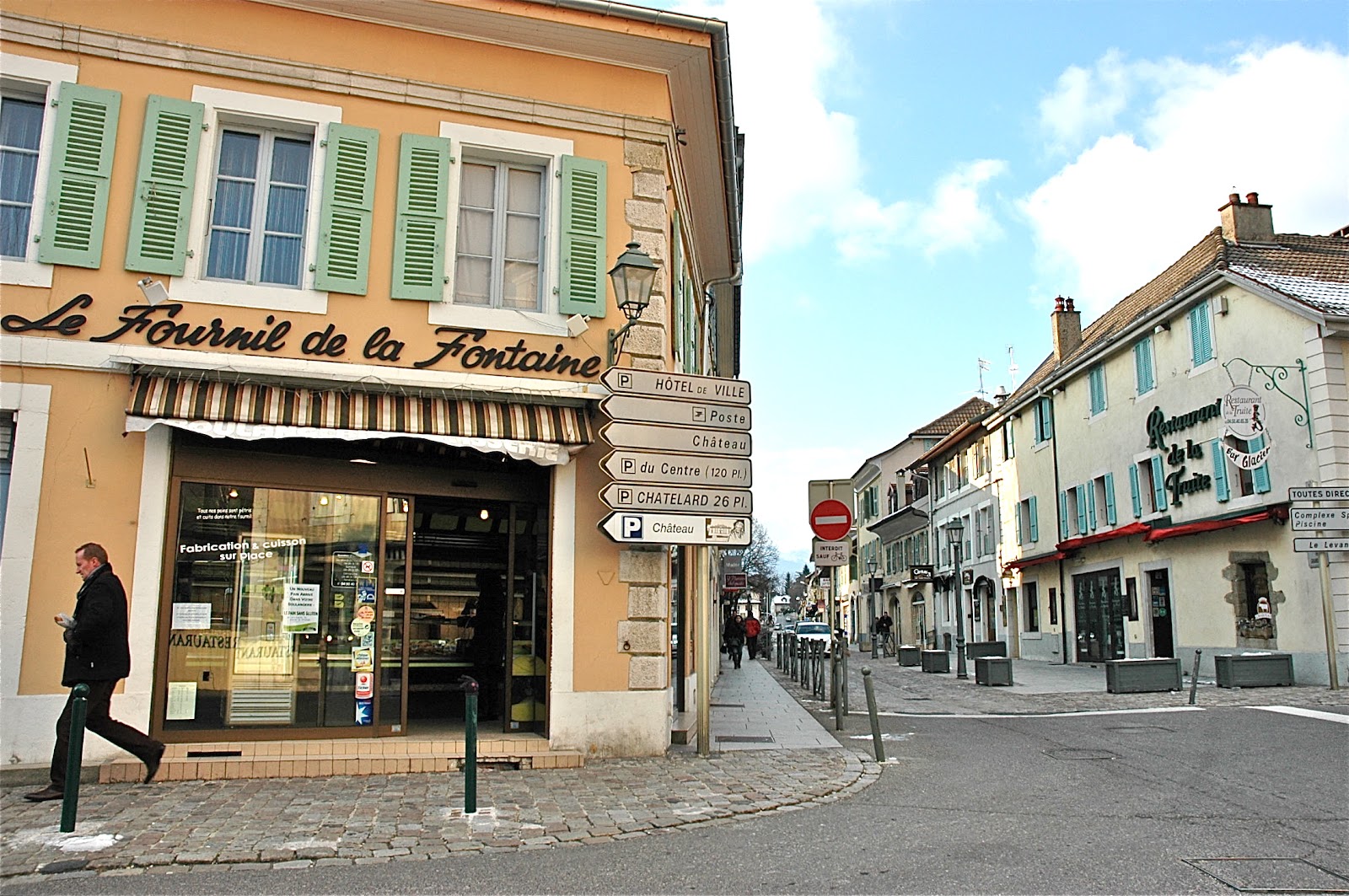
To arrive at the heart of Ferney-Voltaire from our apartment, we walk down Rue de Meyrin for ten minutes and pass several houses that were built during the time that Voltaire had lived in the town.  We reach the corner of a one-block cobblestoned pedestrian street with the ironic name of Grand Rue.  On one corner of this intersection is the boulangerie-patisserie where we buy bread in the morning.  On the other corner is the only bookstore in Ferney, a restaurant called “Le Patriarche,” and in front of that is the fountain that Voltaire had built.  Across from the bookstore (caddy-corner from the boulangerie) is the Hotel France, which had been the home of Voltaire’s secretary over 230 years ago.

Grand Rue

Boulangerie-Patisserie

Voltaire's fountain, Ferney's bookstore

Hotel de France
If we walk up the pedestrian street, we pass restaurants, cafes, boutiques, and one of the best cheese stores in the area.  Then we come to the intersection of Ferney’s only two-lane shopping street, Avenue Voltaire, where we find a small supermarket, pharmacy, flower shop, organic food store, some electronics shops, the post office and town hall, and the statue of Voltaire.  On Saturdays, the largest outdoor market in the region transforms Avenue Voltaire into a carnival of fruits, vegetables, breads, cheeses, meats, fish, olives, candy, clothes, dishware, and people.
Ferney-Voltaire isn’t on the tourist map.  But maybe it should be. 


Wednesday, February 1, 2012

CERN Wife


I'm sitting, for the first time in my life, in the CERN library.  Why?  Because somewhere in our apartment building, and I think it's from the floor above us, construction is going on, and the earsplitting wheezing, whistling, whining sounds of saws screech and pulsate into every room.  Even the best earplugs I own don't help.  My way of escaping the cacophony was to flee our flat in Ferney-Voltaire, France, the town where we're living for a year, to the library at CERN in Meyrin, Switzerland - an eight-minute drive.  Being the spouse of a CERN physicist does have its benefits.

CERN is the French acronym for “Conseil Européen pour la Recherche Nucléaire” (European Council for Nuclear Research), founded in 1952 to develop a European fundamental physics research institute.  By 1954 the laboratory was created, and the name changed to the “European Organization for Nuclear Research” (l’Organisation Européenne pour la Recherche Nucléaire).  But the acronym, CERN, remained.


A view of some CERN buildings

Cutting-edge science occurs here. In a vast campus of dilapidated barracks, tin sheds, stained concrete structures, and a few well-designed buildings, physicists from 84 countries examine collisions of particles that occur in a 27-kilometer circular tunnel that is buried 100 meters underground.  In teams of hundreds, they are working to find answers to essential questions about matter and the universe.


Barracks that are scientists' offices

The ATLAS building

CERN's main site is in Meyrin, on the outskirts of Geneva, with subsidiary facilities in the nearby French countryside where corn grows in the summer and sunflowers in the fall, and where cows munch on grasses from the spring until frost forms.  In a tunnel 328 feet below these fields and villages surrounding CERN, collisions reach temperatures 100,000 times hotter than the sun.

My husband studies the quark-gluon plasma, which is created during violent collisions of particles in the tunnel’s accelerator.  His interest in such physics comes from a curiosity to understand the big bang.  My interest, on the other hand, is people, and I am curious about similarities and differences in human cultures.  I studied anthropology.  But I’m here, not as an anthropologist, but as a CERN wife.  And it’s in that context that I am writing this blog.  In fact, blogging might not have been possible without CERN, which claims to be the place where the world wide web was invented.

This CERN library is more silent than the anthropology library where I devoted so much time when I was writing my dissertation.  Two young men are sitting three tables away absorbed in their computers.  No noise but the occasional hum of a copy machine.  What a pleasure.