Sunday, May 6, 2012

Picard's Foods

The Picard store in Ferney-Voltaire


Picard is my favorite French grocery store.  Although they don’t carry milk, cheese (a necessity in France), seltzers (or wine and beer – additional necessities), salad greens, and some other staples, which means I make the rounds of different food markets, Picard is a specialty-item enterprise: they sell frozen foods. 

Picard's rows of deep-chest freezers

Picard’s stores look somewhat sterile, with rows of deep-chest freezers packed with tempting packages whose alluring graphics of the foods within entice buyers like me to pick up more foods than the tiny French freezers could hold.

Flash-frozen fruit

The company flash-freezes fresh produce or prepared products, which preserves their texture and taste.  Picard’s non-GMO foods are gourmet, flavorful, well-made, easy to use, and do not have artificial preservatives or flavorings.  But what makes Picard my favorite French grocery store is the choice and the fact that whatever I buy doesn’t taste like frozen food.  Take, for example, frozen spinach.  In the US, I could buy a 10 oz block of frozen spinach, but what if I want to use just a quarter cup?  I’d have to take a hammer or saw to cut it up, or thaw out the entire thing and toss most of it out.  Picard’s frozen chopped spinach, on the other hand, like all their pureed vegetables in bags, are molded into individual little rectangles, around an inch by an inch and a half, and maybe a quarter of an inch thick.  I just pour out as much as I need and freeze the rest.

Frozen cubes of pureed peas, pumpkin, and spinach

Whether I buy frozen fresh vegetables, like cauliflower florets, peeled fava beans, or chanterelle mushrooms, or a vegetable mixture such as a Moroccan tagine or grilled eggplant and peppers, or salmon wrapped in puff pastry, or vegetarian pureed soups, or some sort of ethnic food (such as frozen Indian, Japanese, Mexican, Thai, or Moroccan meals), or herb mixtures or sauces, or any of their mouth-watering cakes and ice creams, preparing everyday gourmet dinners feels like cheating. 

Appetizers


Pureed soups (all vegetarian)


Fish


Ethnic vegetable mixtures


Crepes


Tartes and Quiches


Japanese foods


Cannelloni (Manicotti)


Thai foods


Cakes


Desserts (no calories, of course)


Ice cream confections


Ice cream desserts


The Picard insulated bag


One small purchase in my Picard bag

Like many French women (yes, women still do most of the cooking), I’ve become dependent on Picard, and I dread to think that, when I return to the US, I’ll have to make from scratch so many of these foods that I buy frozen in France.  Maybe we can get Trader Joe’s to carry more of Picard’s items (in fact, some of Trader Joe’s frozen foods from France are Picard products with TJ’s labels).  Better yet, maybe we can get Picard to open some stores in the United States – starting with Oakland, California.

The one frozen Picard item we don't need in the U.S.


Tuesday, May 1, 2012

May Day

Lilies of the Valley


May Day in France is a national holiday: children don’t go to school and most employees get the day off; the post office and banks don’t operate; supermarkets and many businesses are closed.  It’s a day to commemorate workers’ rights.  In fact, May Day as a workers’ holiday started in the United States during the latter decades of the 19th century, when workers organized to demand an 8-hour work day, which actually didn’t go into effect in the U.S. until 1938 (whereas in France, workers obtained the 8-hour day in 1919).  While May Day is celebrated throughout most of Europe, contemporary Americans have no collective recollection of the holiday’s history because of its suppression in the United States since the mid-1950’s, when the Cold War dominated American political ideology: the United States associated May Day with communism since the Soviet Union celebrated workers on May 1.  The American myopic view of May Day as a communist holiday ignores its ancient pre-labor roots.

The first of May prevailed as a pagan festival before Christianity conquered Europe.  The Celtic holiday of Beltane celebrated fertility, fire, and the beginning of summer on May 1, and the Vikings observed the evening of April 30 lighting bonfires to scare evil spirits and witches, and to hasten the fertility of spring and summer.  This festival became known in the Germanic-speaking and Eastern European countries as Walpurgis Night, named after a nun named Walpurgis in Germany who spoke out against witchcraft and sorcery.  She was canonized on May 1, 779 – thus transforming pagan festivities into a saint’s day.

And then, of course, there was the Maypole dance and the May Queen (or Queen of the May) derived from old Anglo-Saxon celebrations, which, like the others, were fertility festivals.

I remember when my first grade class did a Maypole dance.  The girls wore pastel frocks; the boys dressed in pants and white shirts.   We wove around the pole, each holding a long strip of light-colored crepe-paper, ducking in and out of the ribbons as the boys circled in one direction and the girls in the other until the pole had been laced with the crepe-paper and we could dance no more.  In the fall of that school year we six-year-olds had to remember to add “under God” to the already-difficult-to-say Pledge of Allegiance - which transformed the incomprehensible words (what’s a “witch-it stands”?) into a public prayer -  to make sure we weren’t godless communists.  After that spring, the Maypole dance wasn’t performed in school.  It had become a symbol of May Day, which had become a symbol of communism.

But here in France, May Day is the workers’ day (La Fête du Travail), and it is signified by the lily of the valley (muguet) because, so it is said, King Charles IX was given lilies of the valley on May 1, 1561, and since he liked the flowers, he presented them to the ladies of his court every May 1 from then on.  Thus the other moniker for May Day is La Fête du Muguet - and on May 1 anyone can sell lilies of the valley without incurring retail regulations or paying taxes.

Yesterday when I went to Carrefour, the hypermarché (supermarket-department-store), displays of lilies of the valley stood in the front of the store.  Nearby, a prominent sign noted that the store would be closed on May 1.  I bought a small potted plant of muguets.  Then at the check-out counter after I had paid for my groceries, the cashier handed me the receipt – and a delicate fragrant muguet sprig tucked into a flower vial. 

This May Day in France has resurrected primary school memories from Poughkeepsie: the Maypole Dance, the transformation of the Pledge of Allegiance, the American association of May Day with communism, and a song from childhood: “White coral bells, upon a slender stalk...” 

Muguet sprig - Lilies of the Valley

Wednesday, April 25, 2012

Sprinter

Weather is not a topic that I thought would make an interesting blog post, because, although I grew up learning to love changes in weather, cloud formations, thunder storms and blizzards (my father had been a meteorologist), weather in Ferney-Voltaire has been what one expects it to be for the seasons.  But these past few weeks have been way too rainy, and the past few days have seemed more like January than late April, with unrelenting rain, cold wind, and clouds hiding the Jura Mountains to the north and the Alps to the south.  This morning, though, the clouds disappeared and the rain had vanished.  The mountains emerged covered with snow, and they tower over fields flowering with yellow rapeseed blossoms that are ready for the late spring harvest.  That’s why I’m writing about weather.  There’s a new season here: Sprinter.

Fields of springtime rapeseed flowers and snow on the Jura

The snow-covered Jura seen from a street in Ferney-Voltaire 

Tuesday, April 24, 2012

The Romans and the Jews

View of the Colosseum (left) and Arch of Titus (right)


One major advantage of being a CERN Wife is travel, because CERN physicists, who come from over 80 countries, have international meetings to discuss their work, and some fortunate spouses tag along as tourists, which I did last week when the ALICE collaboration held a meeting in Frascati, Italy – a half-hour train ride from Rome.  

The Arch of Titus

When I toured Rome years ago, the Arch of Titus had impressed me, and I wanted to examine it once more.  I was discussing the remarkable bas-reliefs on the inside of the arch with my friend Susan, who was with me in Rome last week.  Both of us remembered bas-relief figures of the triumphant Roman soldiers and of enchained Jewish slaves carrying the Temple’s gold Menorah, which the Romans took while sacking Jerusalem in 70 CE.  But before heading to see the arch, which is in the Roman Forum, we spent several hours in the Colosseum, and were most surprised by one placard where it was written that the Colosseum was financed by “booty” from the “Jewish Revolt” against Rome.  WHAT?  Don’t the Colosseum historians know that the Jewish Revolt, led by Simon Bar Kochba, started in 132 CE, whereas construction of the Colosseum began in 72 CE and was completed in 80 CE?  Susan and I were puzzled: why such a blatant anachronism?

Bas-reliefs on one side of the Arch of Titus

Then we walked through the Roman Forum, passing majestic columns, stone paths, remnants of buildings, and current archeological digs and headed straight to the Arch of Titus.  But instead of bas-reliefs of enchained Jewish slaves holding the Menorah, we saw laurel-bedecked proud Roman soldiers parading with the Temple’s treasures.  How could our memories have been so wrong?

Roman soldiers carrying Menorah and other treasures

Victorious Roman soldiers with their horses

The following day we strolled through the old Jewish ghetto, where we sat outside at a kosher restaurant and consumed one of Rome’s most famous dishes – carciofi alla giudia – Jewish style artichokes, which are deep fried in olive oil and transformed into a golden-green crispy flower.  We also visited the outstanding Jewish Museum and took a guided tour of Rome’s Great Synagogue, which was built between 1901 and 1904.  The synagogue tour turned out to be a history lesson about Italian Jews.  Although Jews were brought to Rome as slaves after the destruction of the Second Temple in 70 CE, they had actually been in Rome since the second century BCE, a time when the Maccabees sought the help of Rome to fight the Assyrian Greek Seleucid Empire, which controlled ancient Judea.  Thus, Jews lived in Rome almost 500 years before the emperor Constantine converted to Christianity.  

Rome's Great Synagogue

During the Counter-Reformation of the mid-16th century, which was a Catholic revival in response to the Protestant Reformation, the Jews of Rome were forced to live in the ghetto (starting in 1555).  By 1882, twelve years after the unification of Italy, Jews were permitted to reside outside the ghetto.  Although its walls were demolished in 1888, the ghetto remains a center of Rome’s Jewish identity, with the Great Synagogue, Jewish school, bakeries and restaurants, and plaques commemorating the round-up of Jews during the Holocaust.

Medieval house in the ghetto


Lining up in front of a Jewish bakery


Police guarding Jewish school (right); restaurant (left)


Ghetto building with Holocaust memorial plaque

So what’s with the story about the booty from the Jewish Revolt financing the construction of the Colosseum?  Since our memories about the bas-reliefs on the Arch of Titus were inaccurate, perhaps Susan and I harbored flawed memories about history.  That, indeed, was the case.  There were two Jewish revolts against the Romans, and we remembered the latter one.  We forgot about the first Jewish revolt against Rome between 66-70 CE, which had triggered a major civil war between Jews, resulted in the destruction of the Temple by the Romans, and culminated in the construction of the Colosseum and the Arch of Titus.  These two tourist attractions are reminders not only of ancient Rome’s power and ingenuity, but also of the intertwining history of the Romans and the Jews.


Saturday, April 14, 2012

Self-Promotion and Politics

Sign for Berlitz at Versailles train station


Here is a poster in the Versailles train station, promoting English lessons at Berlitz.  The translation: “Nicolas, Francois, Eva, Jean-Luc, Marine meeting with Barack in 8 weeks…In English, is everything OK?”  Why those names – Nicolas, Francois, Eva, Jean-Luc, Marine?  These are the five top contenders for the presidential race in France.

Actually, 10 hopefuls are running in France, from the extreme left, Eva Joly, to the extreme right, Marine Le Pen, with the center-right current president, Nicolas Sarkozy, battling the Socialist, Francois Hollande, as the top two contenders. 

In Ferney-Voltaire: Posters of the 10 presidential candidates

The French election season, unlike the expensive and long American one, lasts 4 months.  Next Sunday, April 22, is the election, and there might be a run-off election as well.  And because of the concept of laicite – secularism – which is the French political religion, no mention of God is permitted in politics.  French politicians don’t brag about going to church, nor do they mention religious beliefs in their speeches.  Unlike in the United States, religion and politics are separate in France.  No French politician would ever end a speech with something like, “God bless you, and God bless France,” in the way American politicians are obliged to end their speeches as if they are responding to an orchestrated public sneeze (“God bless you, and God bless America”).

The one thing that the presidential candidates of both France and the United States have in common is the personality of self-promotion, because that’s what’s needed to succeed in politics (aside from money and ideas that appeal to a segment of the population).  Just think about Rick Santorum, Rick Perry, and Newt Gingrich: with their bizarre ideologies, how were they able to get such a following?  They have the talent of self-promotion - a flair that facilitated their obtaining financial backing, but in the long run, they didn’t make it as the Republican presidential candidate this go-around. 

Self-promotion is not just for politicians.  In our world of the world-wide web, writers such as Charlotte Bronte and Emily Dickinson would never have been published, because these were shy and introverted women who sat at home and wrote.  They wouldn’t have been able to create a “platform” – the concept so necessary in today’s publishing milieu -   meaning that you are already well-known and have a following, have many people reading what you write, are often quoted, are invited to lecture in front of audiences. In other words, before you can get an agent, let alone a book deal, you have to exist in a Catch-22 world.  Just think of how many contemporary Brontes and Dickinsons are uncomfortable with self-promotion, and as such, we will never read their works. 

I am uncomfortable with self-promotion and the concept of platform development, which writers are told they need to do.  One agent who had agreed to represent my memoir about living in Iran during the revolution rescinded his offer, telling me it’s because I have no platform.  So modest me has to put on the mask of a politician and start self-promotion.  But how?  Just the concept of platform development makes me feel like a phony politician, but without the financial support.  Rather than self-promotion, I’d rather eat ice cream, read, write, paint, drink wine, travel, talk to friends, anything, really, rather than beg people to follow my blog, friend me on Facebook, tweet me with Twitter, or link to me on LinkedIn.  But I do need a platform so I can get an agent so I can get a book published.  In that regard, I need to self-promote, and ask you to follow my blog, friend me on Facebook, and connect with me on LinkedIn.  I (with reluctance) signed up for Twitter – something I thought I’d never do (my Twitter contact, or whatever it’s called, is @KarenLeePliskin).  Why am I doing all this?  Because I’m participating in something called the “April Platform Challenge” by Robert Lee Brewer, from his blog, My Name Is Not Bob.  Platform development is a real challenge for me as both a writer and an artist, and just think, I used to want to be a politician. 


Sunday, April 8, 2012

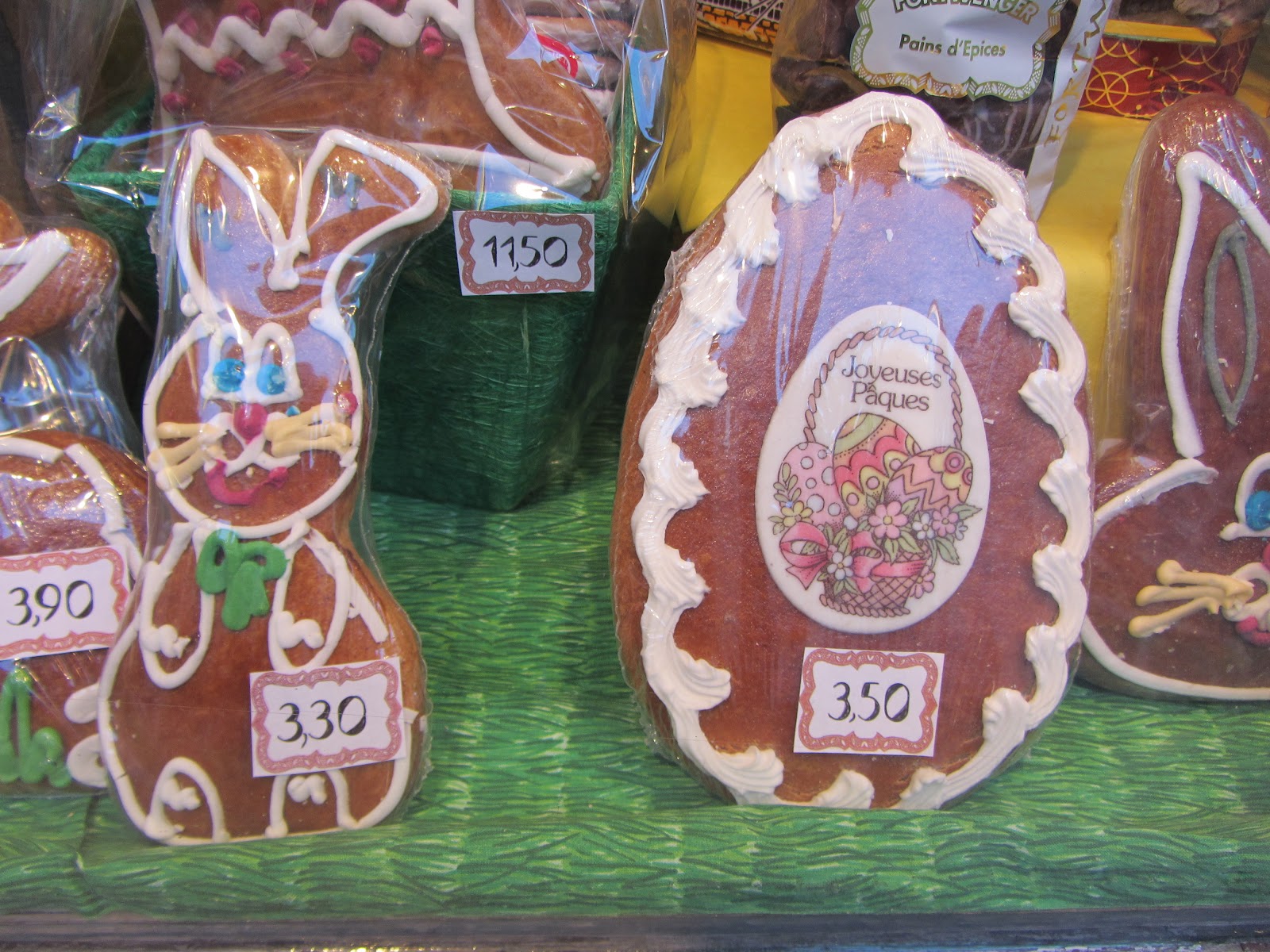
Easter Sweets

Versailles: Bunny and Duck Couples, Hen, and Eggs


Easter sweets appear in patisserie shop windows less than a month before Easter.  Chocolate animals (milk, dark, white, even pink) populate the shelves.

Versailles: Chocolate Cows and Pigs

Versailles: Squirrel

Versailles: Melting Bunny in the Window

Versailles: Melted Bunny in the Window

In Alsace, kugelhopf (sweet yeast cake), cakes made in lamb-shaped or fish-shaped molds, and chocolate storks – the bird of the region – join the chocolate eggs and animals as Easter specialties.

Colmar: Lamb Cakes and Kugelhopf

Colmar: Kugelhopf and Fish Cakes (but not fish)

Colmar: Easter Gingerbread

Colmar: Easter Stork

Colmar: Littler Easter Chocolates

Strasbourg: Cartoony Chocolates

Strasbourg: Gourmet Easter Menagerie

American kids don't know what they're missing.......

Joyeuses Paques and Happy Easter.

Friday, April 6, 2012

Alsace Matzot

Alsace Matsot (r) made in the town of Wasselonne


We spent last weekend, from Friday, March 30 until Sunday, April 1, in Alsace, where French citizens speak French and a dialect similar to Swiss-Deutsch, where the food has a German influence, and where, once-upon-a-time, Jews resided in the cities and villages until the Holocaust.

We toured Colmar, Strasbourg, and Ribeauville, drove through villages and vineyards (Alsace produces mostly white wines: Sylvaner and Reisling the best known), and wondered how is it that in France people still live in houses that were built in the 14th century.  On Sunday, before heading back to Ferney-Voltaire, we went to a kosher grocery in Strasbourg, which has a large (and religious) Jewish population.  We bought all kinds of kosher for Pesach food and wine that doesn’t exist at all in Ferney, and in Geneva the same things (if they have them) are twice the price.

The big box of matzoh made in Wasselone, a village we drove to but didn’t know they had a matzoh factory, towers over Manischewitz matzos.

One piece of Wasselone matzoh


And the size and shape of the Alsace matzoh is different from anything I’ve had in the U.S. or Israel – it’s not only much larger, but each piece can be split in the middle.  Manischewitz here is the midget matzoh.

Alsace matzoh with a midget Manischewitz one


Have a Happy and Healthy Pesach.